


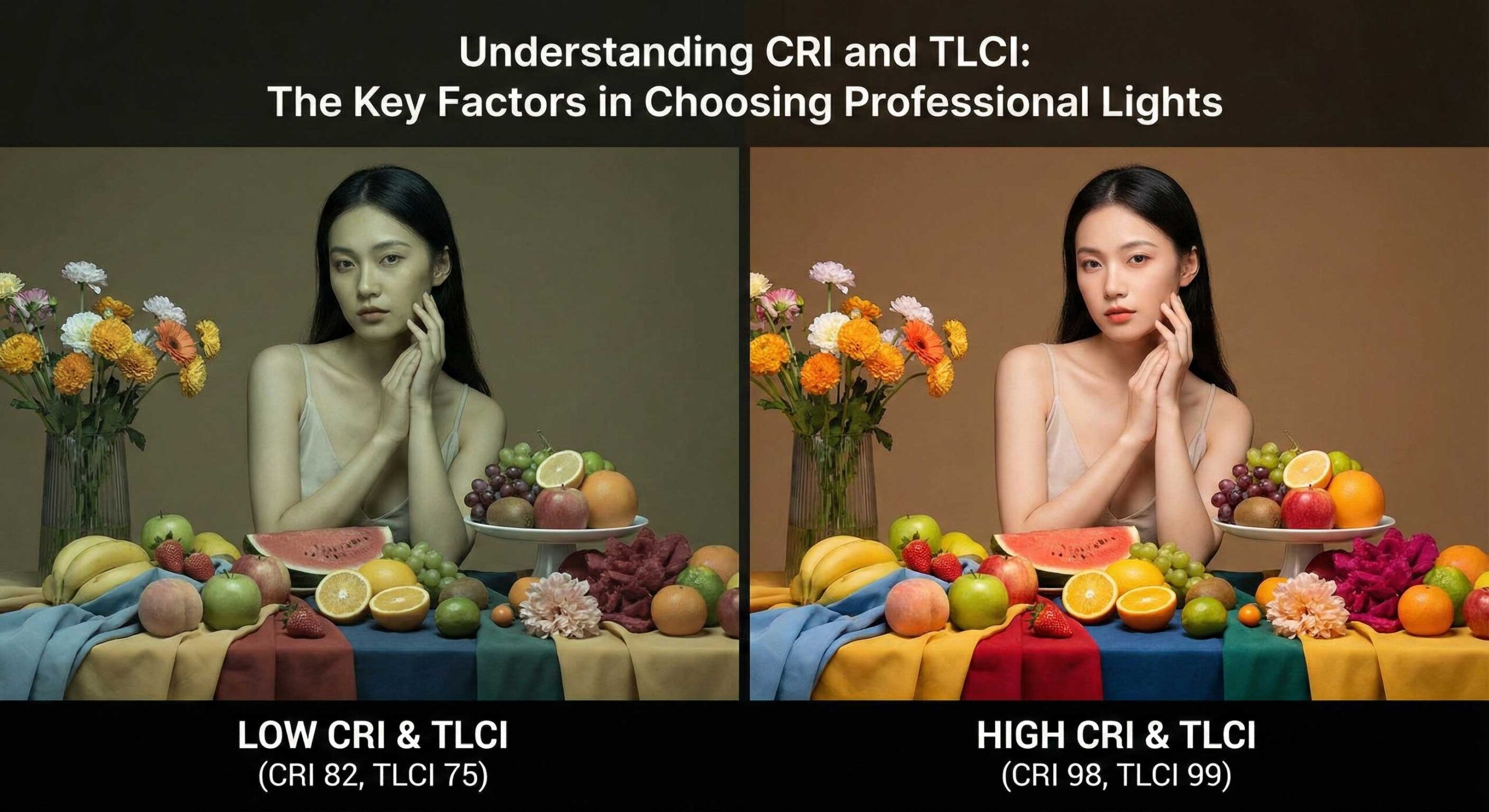
When shopping for professional lighting equipment, you’ll inevitably encounter technical specifications like CRI and TLCI. These acronyms might seem like marketing jargon, but they represent crucial quality metrics that directly impact how your content looks. Understanding what these numbers mean and why they matter separates informed purchasing decisions from expensive mistakes. This comprehensive guide demystifies CRI and TLCI, explaining their significance and helping you choose lights that deliver accurate, professional-quality color reproduction.
What is CRI (Color Rendering Index)?
The Color Rendering Index measures how accurately a light source reproduces colors compared to natural daylight or incandescent light. Developed in the 1960s, CRI provides a numerical score from 0 to 100, with 100 representing perfect color accuracy matching natural sunlight. The system compares how eight standard color samples appear under the test light versus a reference light source.
Natural daylight and traditional incandescent bulbs score CRI 100 because they serve as the reference standards. Most quality LED lights designed for professional use achieve CRI ratings between 90 and 98. Cheaper consumer LEDs might score 70-85, while standard household LED bulbs often fall below 80. These differences dramatically affect how subjects appear on camera.
Why CRI Matters for Content Creators
Imagine filming a makeup tutorial where red lipstick appears orange, or reviewing products where colors look completely different than in reality. Low CRI lighting causes exactly these problems. The light may seem bright and adequate to your eyes, but cameras capture color shifts and inaccuracies that destroy credibility and trust with your audience.
For beauty content creators, accurate skin tone reproduction is non-negotiable. Viewers expect to see realistic representations of how makeup looks in real life. Low CRI lighting can make foundation appear patchy, blush too orange, or eye shadows muddy and indistinct. A CRI of 95 or above ensures what viewers see matches what actually exists.
Product reviewers face similar challenges. If you’re recommending a blue shirt that appears purple in your video due to poor lighting, customers who purchase based on your recommendation will be disappointed. Fashion content demands accurate fabric color and texture representation. Tech reviewers need accurate color rendering for device screens and product finishes.
Understanding TLCI (Television Lighting Consistency Index)
While CRI has served the industry for decades, it was developed for still photography and general illumination rather than video production. TLCI (Television Lighting Consistency Index) addresses CRI’s limitations by specifically measuring light quality for video cameras and digital cinematography.
TLCI uses 24 color patches instead of CRI’s 8, providing more comprehensive color analysis. It accounts for how modern digital cameras process color, reflecting real-world video production more accurately. TLCI particularly emphasizes colors critical for skin tone reproduction, making it highly relevant for content creators filming people.
The scale runs from 0 to 100, similar to CRI. TLCI ratings above 85 indicate excellent color accuracy for broadcast and professional video work. Ratings between 75 and 85 are acceptable for most content creation. Below 75, you’ll likely see noticeable color issues in your footage.
The Relationship Between CRI and TLCI
CRI and TLCI measure related but distinct aspects of light quality. A light can score high CRI but moderate TLCI, or vice versa, though professional lights typically rate well in both metrics. The difference lies in their testing methodologies and intended applications.
CRI uses older reference standards and fewer color samples. TLCI uses modern camera sensors and more comprehensive color testing. For video content creators, TLCI provides more directly relevant information, but many manufacturers still emphasize CRI because it’s more widely recognized and understood.
Ideally, look for lights rating 95+ in CRI and 85+ in TLCI. These specifications indicate professional-quality color rendering that serves both photography and video applications effectively. Lights meeting these standards ensure accurate color reproduction regardless of what you’re filming.
Beyond the Numbers: R9 Values
CRI’s standard measurement uses eight color samples, but a ninth sample—R9, representing saturated red—reveals important information often hidden in overall CRI scores. R9 values range from -100 to 100, with higher numbers indicating better red reproduction.
Red tones matter enormously for filming people. Blood in skin creates red undertones that affect how natural and healthy subjects appear. Low R9 values make skin look pale, sickly, or grayish. Fashion content suffers when red clothing appears dull or shifts toward orange. Food photography loses appetizing warmth without accurate red rendering.
Many lights advertise CRI 95 without mentioning that their R9 value sits at 50 or below. This creates acceptable overall color rendering but specifically struggles with reds. Professional lights should achieve R9 values of 90 or above. Some manufacturers now specify “CRI 95, R9 95” to highlight this important metric.
Real-World Impact on Different Content Types
Different content genres have varying tolerances for color accuracy issues. Understanding these differences helps you prioritize lighting specifications based on your specific needs.
Beauty and makeup content demands the highest color accuracy. Even slight shifts in foundation shades or lipstick colors can mislead viewers and damage your credibility. CRI 97+, TLCI 90+, and R9 95+ represent minimum standards for serious beauty creators.
Product reviews and unboxing content similarly require accurate color rendering. Viewers rely on your content to make purchasing decisions. Showing products in incorrect colors wastes everyone’s time and undermines trust. High CRI and TLCI ratings protect your reputation and serve your audience effectively.
Lifestyle and vlogging content offers slightly more flexibility. While accurate colors still matter, minor variations won’t destroy the viewing experience as they might in product-focused content. CRI 90+ and TLCI 85+ typically suffice for these applications.
Technical and educational content where color accuracy isn’t critical—coding tutorials, talking-head business advice, or similar formats—can tolerate lower specifications. Even here, though, good color rendering makes content more pleasant to watch and appears more professional.
Testing Color Accuracy in Practice
Specifications provide valuable guidance, but nothing beats practical testing when possible. If you can test lights before purchasing or during a return period, simple tests reveal real-world color performance.
Film yourself or a subject under the test light and examine skin tones carefully. Do you look healthy and natural, or pale and sickly? Compare footage to how you appear in natural window light. Film colorful objects—a bowl of fruit, colored clothing, makeup products—and compare to how they appear in sunlight. The colors should match closely.
Check how colors render at different brightness levels. Some lights maintain color accuracy at full power but shift color temperature or degrade color rendering when dimmed. Professional lights maintain specifications across their full dimming range.
The Cost-Quality Relationship
Higher CRI and TLCI ratings typically correlate with higher prices. The LEDs, phosphor coatings, and electronic components required for accurate color reproduction cost more than standard equivalents. This creates a genuine dilemma for budget-conscious creators.
However, buying cheap lights with poor color rendering proves a false economy. You’ll either produce subpar content that hurts your channel growth, or you’ll replace the lights quickly anyway when you recognize their limitations. Investing in quality lighting from the start saves money long-term while ensuring your content maintains professional standards.
That said, not every light in your kit needs premium specifications. Your key light absolutely deserves high CRI and TLCI ratings because it illuminates your subject directly. Background lights can use moderate specifications since they’re not directly illuminating faces or products. This strategic approach balances quality and budget effectively.
Evaluating Manufacturer Claims
Not all manufacturer-provided specifications are created equal. Some companies use optimistic testing methods or cherry-pick their best samples for testing. Independent testing by lighting reviewers provides more reliable information than manufacturer claims alone.
Look for lights that third-party reviewers have tested and verified. Photography and videography communities often share detailed measurements using professional testing equipment. These independent verifications reveal when manufacturers exaggerate specifications or when lights genuinely deliver advertised performance.
Be particularly skeptical of lights claiming CRI 98 or 99 at unusually low price points. While LED technology has become more affordable, achieving the highest color accuracy still requires quality components and careful engineering. Extremely cheap lights claiming premium specifications are often too good to be true.
Color Accuracy vs. Other Factors
CRI and TLCI represent important but not exclusive considerations when choosing lights. Brightness, beam angle, color temperature adjustability, build quality, and practical features all matter too. The brightest, most adjustable light proves useless if its color rendering makes your subjects look unnatural.
Balance color accuracy with other practical needs. A moderately high-CRI light that’s portable and battery-powered might serve a travel creator better than a perfect-CRI light that’s heavy and AC-only. Consider your specific use case and prioritize accordingly.
For fixed studio setups where you’ll use lights for years, maximize color quality within your budget. For portable or occasional-use lights, practical considerations might outweigh marginal color accuracy improvements.
Future Developments
LED technology continues evolving, with newer lights achieving higher color accuracy at lower costs. The gap between professional and consumer lighting continues narrowing. Specifications that required significant investment five years ago are now available at mid-tier price points.
This ongoing improvement benefits content creators at all levels. Budget-conscious creators can now access color quality previously reserved for high-end productions. Professional creators can achieve color accuracy that matches or exceeds traditional lighting technologies like tungsten.
Making Your Decision
Understanding CRI and TLCI empowers you to make informed lighting decisions based on actual quality metrics rather than marketing claims or price alone. For professional content creation, prioritize lights with CRI 95+, TLCI 85+, and R9 90+ whenever budget allows.
Remember that these specifications measure potential rather than guarantee results. Proper positioning, color temperature matching, and thoughtful lighting design matter just as much as the lights themselves. Perfect color rendering from poorly positioned lights still creates poor results.
Conclusion
CRI and TLCI represent essential quality metrics that directly impact your content’s professional appearance and color accuracy. High ratings in these measurements ensure skin tones appear natural, products display accurately, and your overall production quality meets professional standards. While these specifications don’t guarantee great lighting alone, they provide the foundation for color accuracy that post-production cannot fix.
As you build or upgrade your lighting kit, treat CRI and TLCI ratings as critical factors in your decision-making process. The investment in high-quality color rendering pays dividends through better-looking content, increased viewer trust, and professional results that help your channel or business grow. Your audience may not know what CRI means, but they’ll absolutely notice the difference between accurate, flattering colors and the muddy, inaccurate rendering that low-quality lights produce.
Understanding these technical specifications transforms you from a passive consumer accepting marketing claims into an informed buyer who can evaluate lighting quality objectively. This knowledge serves you throughout your content creation career, ensuring every lighting purchase delivers the professional color accuracy your work deserves.